

We know the power of the Internet protocol suite as it takes on the world of telecom. Already half of the Communication has been transferred from legacy telecom signaling protocols like SS7 to IP based communication ( Skype, Hangouts, WhatsApp, Facebook Messenger, Slack, Microsoft Teams ). The TV service providers too are largely investing in IP based systems like SIP and IMS to deliver their content over Telecom’s IP based network ( Packet-switched ).
IPTV
A consumer today wants HD media content anytime anywhere. The traditional TV solutions just don’t match upto the expectations anymore. The IPTV provider in today’s time must make investments to deliver content that is media-aware, and device-aware. Not only this it should be personal, social, and interactive and enhance the user experience.
Few popular applications for IPTV solutions developers :
- Menu overlay with detailed description of channels , categories , programs , movies
- Record and Replay option also referred to as timeshift. It allows a user to pause , resume and record the show in his absence and view it later
- Video on demand which concerns paying and viewing music albums , movies etc on demand
- Live streaming of events such as president speech , tennis match etc .
Application that can be build around the IPTV context
- Record and Playback content
- Information overlay on streaming content
- Social networking services integrated with IPTV content
- Parental Control to realtime view , monitor and control what your child is watching on the IPTV
- Watch the surveillance footage from IP cameras anywhere
- Real time communication on IPTV with advanced features like call continuity , content sync .


Key Components for IPTV service includes
- IPTV client such as a set top box (STB) or smart TV which is capable of processing SIP packets to initiate and terminate SIP streams
- SIP is also used for channel switching
- SIP proxy server which can route messages between IPTV clients and media server
- Media server that can deliver RTP/RTSP streams
- RTSP manages playback (play/pause/seek), while RTP delivers video
- IMS core which can employ its node for QoS, billing and other SIP based processes
IPTV multicast
In this case a single stream is sent to multiple users simultaneously.
Uses UDP multicast (IGMP) to efficiently distribute live TV.
However this requires multicast-enabled routers (PIM, IGMP snooping).
Since 1 stream serves thousands, this approach is suitable very scalable media streams such as Live sports or concerts. Also in contrast to unicast IPTV this approach avoids duplication on network links since viewers watching a single stream are added to a group.
| IPTV unicast | IPTV multicast |
| 1-1 flow of media | 1:many flow of media where Server rs[ponds with multicast group and STB joins the IGMP multicast group to receive the stream. |
| scales with horizontal scalability of media server | Employs CDN based edge caching , Prebuffering for fast access |
| Better for personalized ads/targeted content with more user control for rewind | No user control due to linear shared stream |
Mobile TV
Mobile TV is an advanced services that lets users download and play songs and videos, send text messages, conference with colleagues and friends, and exchange pictures or videos on whichever device they are using.
Mobile TV Service platform bundles different types of content (live TV, VoD, podcast, etc.) into IP service streams and selects the transmission bearer depending on the targeted audience.
- broadcast (DVB-H or DVB-SH based)
- unicast (2G, 3G, etc.)
DVB-H standard is optimized transmission on broadcast technology for hand-held, low power devices.
Components
- bearer selection
- Electronic Service Guide (ESG) to list the available programs and contents.
- Streaming servers
- Video Encoders
- rich media service node
- Add-on
- recommendation engine
- personalized advertising
- audience measurement
- Content and subscriber management

- (+) use existing cellular networks
- radio sites and antennas enhanced with broadcast repeaters
- (+) direct reception via satellite
Video On Demand (VoD)
Video on demand using Adaptive Multirate dispatch using a Transcoder. This enables flexible playback over unicast streams.
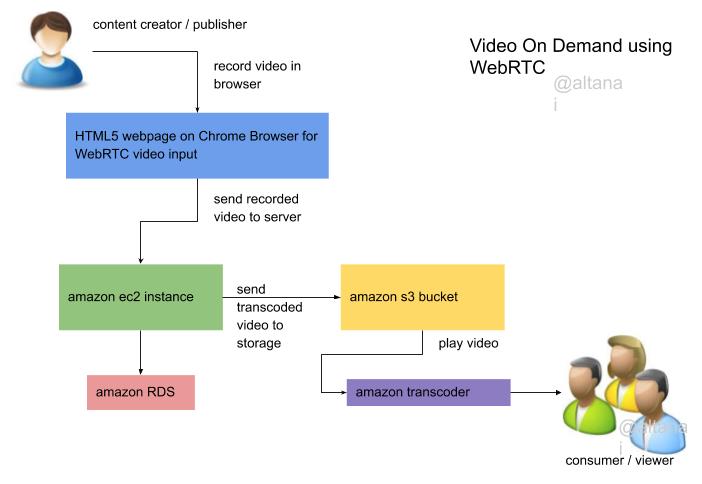
Components
- HTML5 webpage on chrome browser for WebRTC input : contains the client side script to record the video and send the blob to server side for processing.
- Amazon EC2 instance : The amazon ec2 instance hosts the web interface for login and video recording . It converts the incoming blob / webm format to mp4 . After the video conversion it uploads the video mp4 to s3 bucket.
- Amazon S3 bucket : The s3 bucket is connected to the transcoder via pipeline and holds the video storage as well.
- Amazon transcoder : The transcoder provides adaptive multirate dispatch on viewer access .
- RDS for any mysql storage ( optional ) : Optional for record keeping credentials, storage links, linked information etc.

WebRTC for IPTV and VOD
WebRTC has been applied in the basic communication sector with overwhelming results. However there the capability to stream media is not just limited to communication it can be applied to stream multimedia content from streaming servers as well. This section describes the application of WebRTC in IPTV ( IP Television ), VOD ( Video on Demand ), Online FM ( audio from Radio stations online ) applications. All this without the need to download plugins or any additional installations of third party products. Also with the inclusion of the
An architecture representing some of these use cases in the context of WebRTC based media transmission is depicted below.

References:
- RFC 3515 The Session Initiation Protocol (SIP) Refer Method
 Telecom R & D
Ola
great share.
I consider the great premium iptv servers are those from Fishbone IPTV cloud
I would like to see more posts like this
Thanks
Hi
Good share.
In my opinion the great cccam server are those from fishbone cloud
I would like to see more posts like this
Thanks